
Concerns over projects costs and the impact to taxpayers yielded only moderate support for the options presented in the North Peace Leisure Pool replacement project, Peace River Regional District directors were told by the consultants who conducted the public consultation portion of the project.
In fact, of the four jurisdictions that would be paying for the replacement North Peace Leisure Pool, only residents of Fort St. John showed strong support for the project. Areas B, C and the District of Taylor were either less than 50 percent supportive, or less than 50 percent likely to use the proposed new facility.
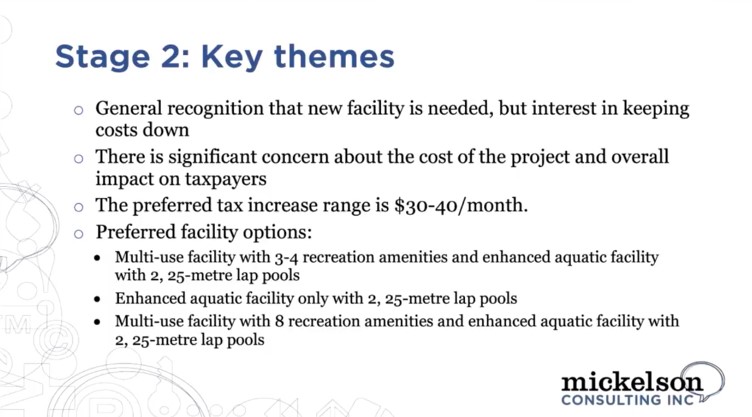
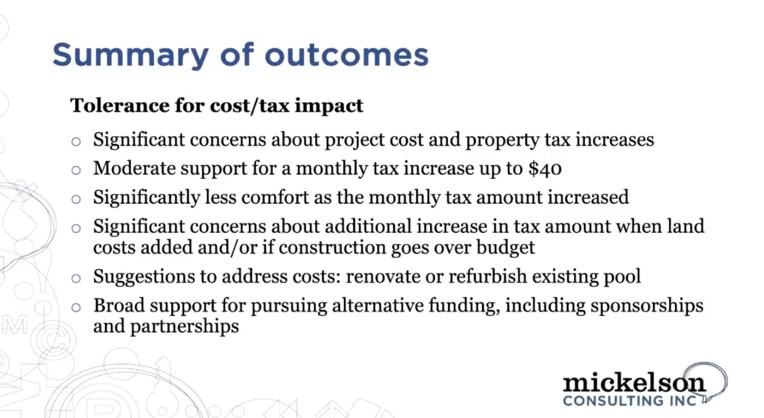
Therese Mickelson, of Mickelson Consulting which conducted the public engagement said that residents have significant concerns about the cost, although they do recognize the need for a new facility.
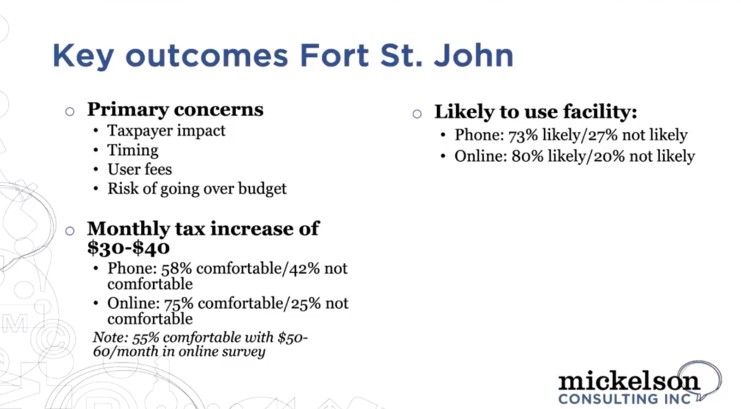

“There was moderate support for an increase of up to $40 per month in property taxes. I say moderate because in some jurisdictions that wasn’t even supported,” Mickelson said. “There was significantly less support as that amount increased.”
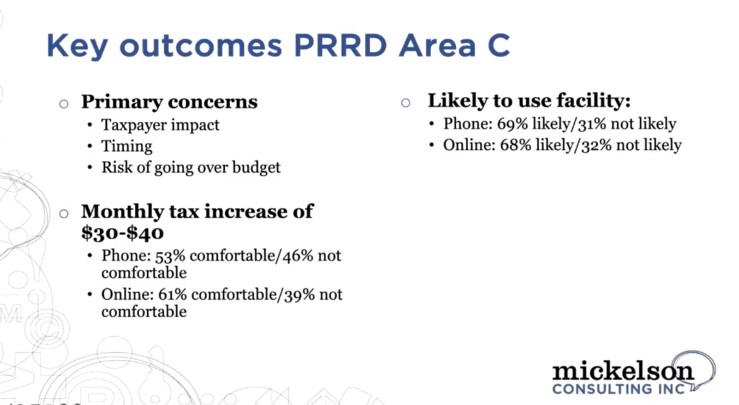
Most residents found that the increase in property taxes were just too much, although they may support the idea of a new pool. In the city, more residents were comfortable with the idea of paying $40/month more on their property taxes, and some were happy with an even greater tax hike to cover the proposed amenities. Most of Area B and Taylor residents were not comfortable with a $40/month increase. Area C residents were more receptive to this increase those surveyed said they were also more likely to use the facility than Area B and Taylor residents.

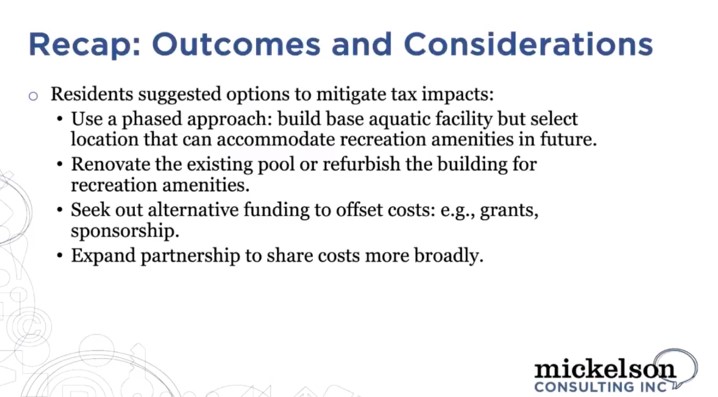
There was, however, broad support for the possibility of pursuing alternative funding, such as sponsorships and partnerships to keep the costs to taxpayers down.
One of the biggest bones of contention surrounding the project was the way the public consultation was conducted. Some residents who appeared at the Committee of the Whole meeting on July 4 to give their feedback on the project and hear the results of the latest round of consultations, said that they hadn’t known about the two previous consultations – held in 2018 and 2020 – and that this round was poorly executed.

Residents also wrote to the Board to express their concerns about the whole process. One resident, Gary Brimacomb, wrote that he is very concerned about the lack of transparency around the pool project.
He said that he attended the workshop in Fort St. John with a group of four others, who were all initially denied entry because they had not registered in advance. “After much fighting, they finally admitted the five of us.”
“There were at least 50 people behind us, also trying to enter that were all turned away. I’m not sure how you can have honest discussions if this is the case.”
Another resident, Carol Kube, wrote that she felt the process lacked transparency. The August 2022 engagement summary report, which covered the 2020 public consultation, stated that 18 stakeholder groups, and 1455 online survey respondents participated, but there was no mention of who these stakeholder groups were.
Kube mentioned her concern that there is no mention of the cost or location of the land for the project.
“Why is the cost of the land, which is not being included, being kept a secret? The cost of this building is as murky as Fish Creek,” she wrote. “I’m unsure how you can get someone to commit to a project without knowing the true cost.”
Gwen Bourdon, who was present at the COW said she was told that “the size of the pool dictates the location. I was told there are anywhere from two to six different site options.”
“We still have to pay for the land and land prices are going up.”
Another concern with the consultation process is that although the project affects thousands of taxpayers in the region, between the workshops, Open House and online survey, only 1568 people out of a population of approximately 37,000 responded.
As resident Deborah Johnson told the directors, this small number of participants “will decide the fate of who will pay the taxes for this pool.”
“How many people in the survey said no? Why would we waste more taxpayer dollars going to referendum if the consensus is actually no,” Johnson asked.
Mickelson noted that the engagement showed there were also concern about the referendum. “People need to know all the costs before going forward with a referendum,” she said. “There’s also the frustration that renters vote, but don’t pay, as per provincial legislation.”
Pam Ryan, of Lucent Quay Consulting which partnered with Mickelson to conduct the engagement, said that there is a slim majority of support for the project as it is currently proposed.
“People really want to know the cost of the land and the taxation model before going forward with a referendum,” Ryan said. “There’s also a concern that this is really not a good time (for a big project) due to the economy.”
Area B director Jordan Kealy said that he attended one of the workshops and said that although online and in the phone surveys people were given the option to choose “no”, that wasn’t the case at the workshops.
“You were trying to keep them focussed on Option one, two or three,” Kealy said. “At the workshop we were not given that option, I think that’s where we’re having confusion.”
Mickelson said that workshop attendees were told to write on their worksheet if they were not in favour at all. “That’s how we got those numbers.”
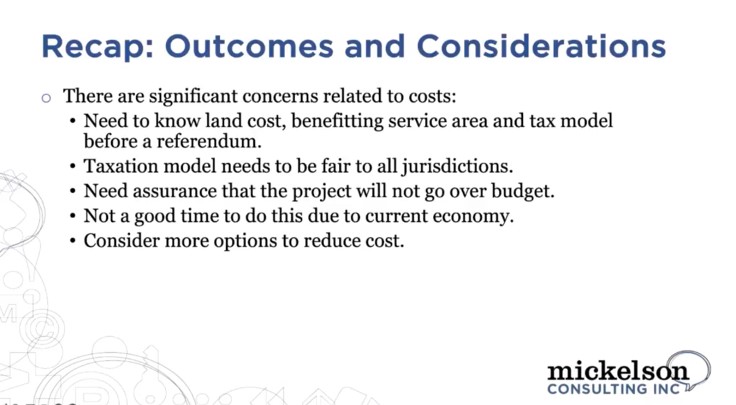
Throughout the public engagement, Mickelson said that the cost tolerance among residents was not very high. “We consistently heard a concern about what this cost means to them, and the tax impact. What came through was, yes, we want this, but it’s more than a lot of us can afford.”
“That is an over-arching theme of what we heard.”
This concern was echoed by Kealy when he said that he’d found, from talking to his residents, that many people, especially seniors, cannot afford an extra $500 per year in taxes.
“We don’t want to get to the point where they have to choose between food and the tax base for a pool,” he said.
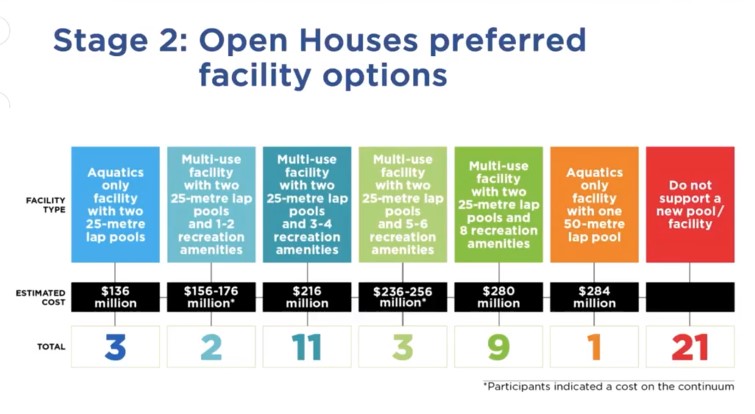
Fort St. John city councillor and Chair of the North Peace Leisure Pool Replacement Steering Committee, Trevor Bolin asked Mickelson if the 21 people, who said at the Open House that they didn’t support a new pool, were aware that “in seven years the current pool will no longer be functioning as it currently is right now? That if they were a no, there will be no pool in the region?”
Mickelson said that they provided “very clear information” that the infrastructure of the current pool is failing, and that if people said no, there would be no pool. “Their response was that we don’t need a pool as much as we need to be able to afford to keep our property,” she said.
This is the first in a series of articles about the next steps in the North Peace Leisure Pool replacement project. Please stay tuned for more on this developing story ~ Tania

Have an insight or additional info regarding this article? Feel free to drop a comment!