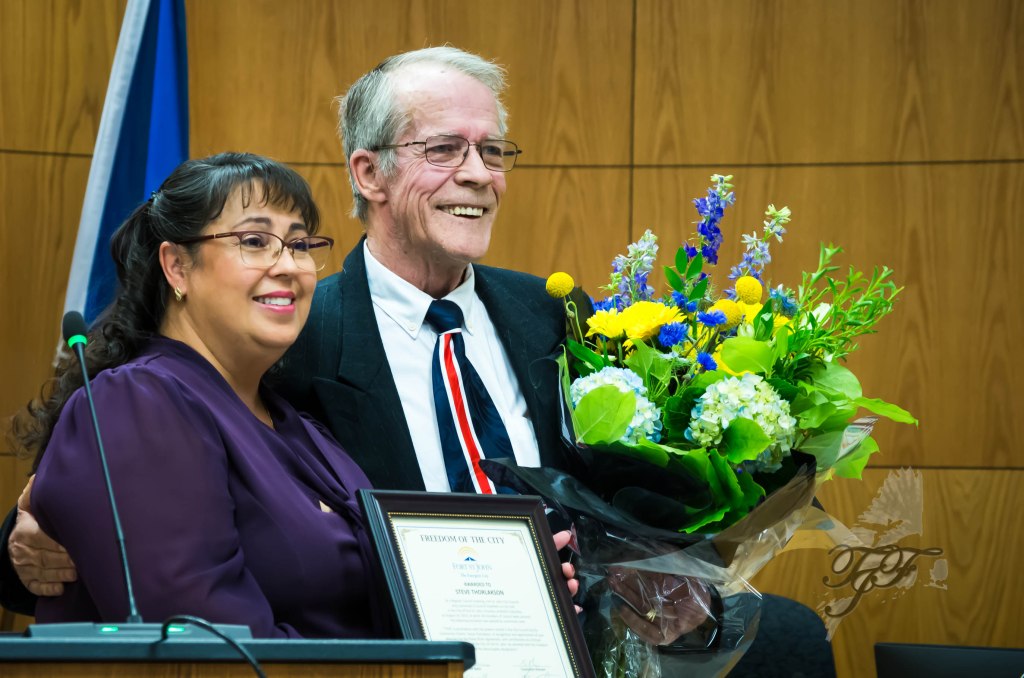
Like a lot of people who come to Fort St. John, when Steve Thorlakson moved here in 1979, he came here for a job. As manager at the TD Bank, Thorlakson had no plans to run for council, to become mayor or solve the city’s infrastructure issues, he just came here to work.
And as he drove into town from the airport on that August day, he was shocked at the state of the city.
“It was ugly. It was lumps of gumbo everywhere, it looked dirty, it looked crummy. And I thought, it’s a place that I guess I can live for a year.”
Now, over four decades later, not only has Thorlakson now spent more than half his life in the city, but he has played a key role in turning the fortunes of the community around.
That role began when he left the TD Bank in 1980 and joined Falkenberg Agencies. Thorlakson also joined the Chamber of Commerce, and by 1984 Thorlakson was the vice-president of the Chamber, and his friend Peter Vandergugten was the president. The Chamber was nearly bankrupt at the time, with $60,000 in debt and the local economy was in dire straits.
“We had 40 percent residential vacancies, 40 percent commercial vacancies – you could’ve fired a cannonball down 100 Avenue and not hit anything at rush hour,” he said.
So, Thorlakson and Vandergugten decided to try to turn things around. Giving back to the community and trying to make things better for others became a passion for Thorlakson.
Within two years, the pair had gotten the Chamber out of debt, increased the membership for 140 to 400 and turned their attention to the city itself.
“We thought that we could make the same difference at the city as we made at the Chamber.”
Both men were elected to city council in 1986. Like the Chamber two years earlier, the city was nearly bankrupt, Thorlakson said.
Business taxes in the city were three times the provincial average, residential taxes were double, people simply couldn’t afford to live or run a business in Fort St. John.
“They had 500 tax-sale properties that they’d taken back for non-payment of taxes, worth $6 million, but that represented money that had already been spent. All of that property at that time had no value, because you had an economy that was in the crapper,” he said. “If you have no willing buyers, the asset that you’re trying to sell is worth nothing.”
In 1990, Thorlakson ran for mayor, beating out incumbent Pat Walsh. At that time, the city was still in financial difficulties, and the city’s infrastructure was in desperate need of upgrading, as he had noted upon his arrival ten years earlier.
The Freedom of the City is the highest honour given by the City of Fort St. John and is used in exceptional cases to recognize the significant contributions the recipient has made to our community.
It was clear to Thorlakson that things needed to be looked through a solid business lens.
“We had about $150 million worth of infrastructure backlog, we had dirt roads all over the place – there’s a famous photograph of a front-end loader trying to pull a grader out of the road, that was stuck in the mud right up to the axles – our issues were the case for Fair Share.”
The city manager was retiring, and Fort St. John needed new blood, and a new vision to help council solve the issues plaguing the city. They looked to Fort Nelson, and that community’s city manager, Colin Griffith for help.
Griffith had been instrumental in regionalizing the tax-base of Fort Nelson and its surrounds, which had previously been in Area A of the Peace River Regional District, into its own regional district, the Fort Nelson-Liard Regional District.
Thorlakson said what Griffith accomplished in Fort Nelson “was nothing short of spectacular,” and wanted that sort of initiative and vision for Fort St. John.
The city had to get its fiscal house in order, which it did by implementing freezes on property taxes, freezing the number of city employees at 110 people, and prohibiting borrowing funds for anything other than water and sewer projects.
Also, the city needed rebranding. The slogans of Land of the New Totems and City of Opportunity were not representative of the community and were often mocked by residents. The city, with the help of the Chamber and consultants got to work to rebrand the city, and came up with the Energetic City, a moniker which has stood the test of time, and is still used today.
The completion of the North Peace Cultural Centre set a precedent for other facilities in region.
It was a project that Thorlakson said was dividing the community, with some seeing the unfinished shell of the former Bay building and what it would become as a beacon of hope, others seeing it as a cancerous scar on the downtown.
Then-MLA Tony Brummet had secured a million dollars for the first phase of the project, but it was lacking a plan and the commitment to finish it. Moray Stewart of the Peace River Regional District came up with the idea of regionalizing the project, Thorlakson said.
“Taylor and Fort St. John signed on as partners to borrow the money,” he said. “That got us a million bucks, that got the Cultural Centre done and it opened in 1992.”
Regionalizing the Cultural Centre became something of a model for getting things done, that benefitted the rural areas as well as the city. Chetwynd, which had regionalized some services and had access to some of the industrial tax base, was proof that it could be done, as was Griffith’s experience in Fort Nelson.
But first, the communities had to get the provincial government to recognize that northeastern British Columbia deserved more than they were getting.
Oil and gas, forestry and mining were prime drivers of the provincial economy, but the communities that supported these industries, where their companies had offices and employees lived were in a sad state.
Fort St. John in the 1990s was in a sad state. The city had over 40 kilometres of unpaved roads, and that was just the start. Its water source, Charlie Lake, was drying up and by 1994 with the water coming from the taps taking on a green hue, the matter became urgent. The city’s pool got condemned and was closed, and the federal government decided to download operations of 18 airports in the province to the municipalities.
Access to the industrial tax base became critically important for the whole region.
Thorlakson and the mayors of other municipalities joined forces in a coalition to ensure the communities of the region got their fair share of the industrial taxbase.
The first step was coming up with an allocation formula which is still used today. After much research and with the support of industry, the coalition was able to present their needs and proposed solutions to the government in Victoria, because as former City Manager Colin Griffith said, “you don’t take problems to Victoria, you bring solutions.”
Finally in 1994, the government agreed to provide $4 million per year for four years to be distributed amongst the communities in the region. But this amount wasn’t adequate. The NDP government refused to reopen the agreement, so the coalition decided to interfere in the 1997 public hearings for the Aitken Creek Gas Plant, opposing its proposed construction because the communities which supported the industry were not getting adequate support.
In the spring of 1998, the government came back and presented an offer of $12 million per year for ten years.
The city’s troubles didn’t end there.
The water supply problem had been solved in 1997 with the wells in the Peace River at Taylor. Through regionalizing the services, the North Peace Airport Society was formed to run Fort St. John’s airport; a new pool had been built after going to referendum three times before the residents of the city, and Areas B and C of the Regional District approved the project.
But in 2001, the province decided to download the ownership and maintenance of 100 Street and 100 Avenue which had been provincial highways, to the city. The roads were in bad shape from the heavy truck traffic going through the city daily.
Thorlakson and city council banned heavy truck traffic within the city. Using Fair Share dollars, they were able to make repairs, and eventually long-after Thorlakson left public life, the city upgraded 100 Street and the infrastructure beneath it, into the main street the city’s residents and visitors traverse today.
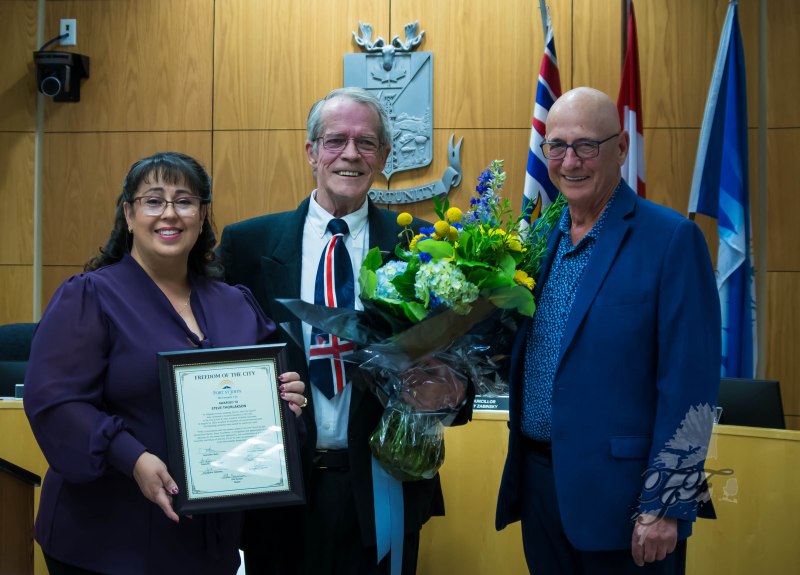
At the July 15 Freedom of the City presentation, Thorlakson said he couldn’t have achieved all that he did without the support of not only his family, but all the members of council he served with over the years, and the city’s staff. In fact, he credits former City Manager, Colin Griffith with making things happen.
“Colin is a gifted, brilliant man,” Thorlakson said. “We had the political determination – there was some blood on the floor in the committee room from time to time – he had the wisdom, and the research, policy governance.”
“The smartest thing I ever did in politics was convince council that we should get him. Beyond any shadow of a doubt.”
Griffith however, said that “Nothing happens in local government unless it is lead by the mayor and the council.”
Thorlakson credits his parents, who served in World War II, with instilling in him the passion to serve the community.
“[My parents] told all of us kids – me, my older sister, my younger brother – that you should get involved in your community to pay back for what others had already sacrificed for you,” Thorlakson said. “We took that seriously.”
Mayor Lilia Hansen told those who turned out to see Thorlakson receive what he describes as a “lifetime achievement award”, that Thorlakson has had a profound and lasting impact on the community.
“During his tenure, he led the city through a critical financial turning point, helping transform Fort St. John into the vibrant, livable community it is today.
“Steve’s leadership laid the foundation for our city’s long-term success,” Hansen said. “Because of his dedication, Fort St. John gained the financial stability to invest in roads, parks, facilities and our overall quality of life. His impact touches every corner of our community and will be felt for generations.”
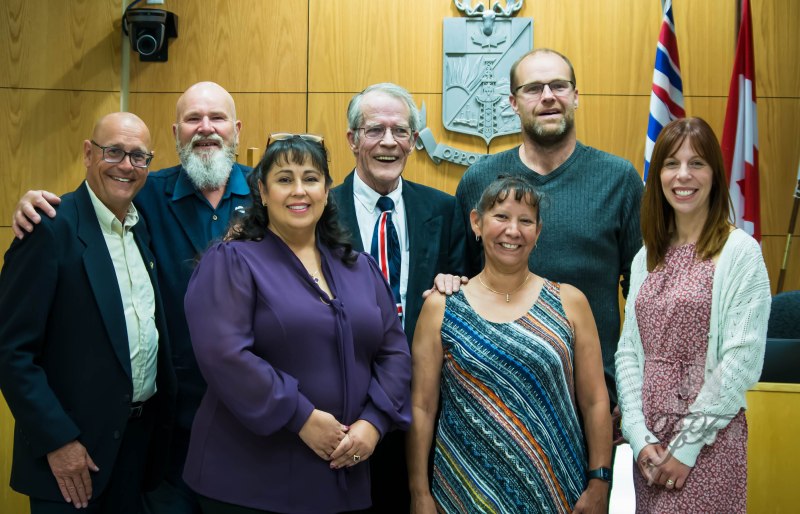
In addition to Mayor Hansen and former City Manager Griffith, MP Bob Zimmer, Councillor Trevor Bolin, Lita Powell all spoke of Thorlakson’s achievements, while in the audience were Thorlakson’s former colleagues, Andy Falkenburg, Janet Prestley who worked for the city for many years and nominated Thorlakson for the award, and members of the current city council.
A video of the Freedom of the City presentation is available on the city’s YouTube channel. For more information about the Freedom of the City Award and previous recipients, visit the Freedom of the City webpage.

Have an insight or additional info regarding this article? Feel free to drop a comment!