Although the most lucrative market for Western Canadian oil, natural gas and liquids remains the United States, petroleum companies with assets in northeastern British Columbia’s Montney Formation, continue to invest in the region through new projects, partnerships and expanding existing facilities and operations.
In their 2025 Q2 reports, ARC Resources, Enbridge, and Tourmaline affirmed their long-term commitments to the region, with plans to maintain and build upon their presence in northeastern BC, despite challenges presented by commodity price fluctuations and the regulatory environment.
Companies waiting on LNG Canada, increased demand
Low Canadian natural gas prices – which at present are well below the cost of supply – have led to temporary curtailments at some facilities, while companies bide their time until prices rebound.
“Currently, we have shut-in all dry gas production, approximately 360 million cubic feet per day (MMcfd) or 60,000 boe (barrels of oil equivalent) per day which will be fully restored when natural gas prices recover,” Terry Anderson, ARC president and CEO said in a conference call to discuss the Q2 results.
Anderson expects that will occur later this year “as the ramp up in LNG Canada coincides with the conclusion of seasonal pipeline maintenance that is underway today.”
“We look forward to integrating this opportunity into our long-term development strategy at Attachie and working alongside Tsaa Dunne Za Energy.”
Terry Anderson, ARC president, CEO
Tourmaline president and CEO Mike Rose said his company also found a need for curtailments in the first half of the year, noting that Tourmaline’s Q2 average production of just over 620,000 boe/day was achieved in spite of reductions related to wildfires in Alberta and “low commodity price periodic shut-ins in northeastern British Columbia and multiple frack activity deferrals into the second half of this year.”
The demand boost created by LNG Canada’s exports will reduce Western Canada’s current oversupply which has kept prices low, and analysts such as BMO Capital Markets estimate the demand surge could sustain higher prices for up to seven years. The production curtailments put in place by Tourmaline, ARC and others are intended to manage the oversupply.
Once LNG Canada reaches full processing and export capacity, the demand for natural gas will increase along with prices, both domestically and internationally.
Shell Canada, one of the partners in LNG Canada, forecasts global demand for LNG to rise by approximately 60 percent by 2040.
Montney investment continues into next decade
To meet that future demand, investment in the Montney formation continues.
In Q2, ARC Resources expanded its Montney investments with Kakwa, an acquisition on the Alberta side of the Montney, and entered into an agreement with Tsaa Dunne Za Energy for the earning and development of a mineral tenure adjacent to ARC’s Attachie asset. Tsaa Dunne Za Energy is a limited partnership of Halfway River First Nation.
“We look forward to integrating this opportunity into our long-term development strategy at Attachie and working alongside Tsaa Dunne Za Energy.”
Although production at Attachie was down in the first part of the quarter due to third-party downtime and production emulsion, Anderson says the plant is now operating as expected, with production reaching 39,000 boe/day, up from 27,000 boe/day.
“Our last three pads have been successfully drilled and completed as planned and are being placed on production as I speak,” Anderson said.
This will provide momentum into the second half of the year, where he expects Attachie production to average between 35,000-40,000 boe/day.
“We continue to evaluate ways to optimize capital efficiencies and returns at Attachie. One example is we have trials in the ground at water inter-well spacing and higher intensity fracks that are generating results above our tight curve.
“Through the initial six months, the average well from this trial pad produced approximately 107,000 barrels of condensate or around 600 barrels per day (bpd).”
Additionally, ARC is investing $50 million in anticipation of Phase 2 of Attachie in 2025, including site clearance and long-lead items for the facility.
“We remain confident in the long-term profitability at Attachie. Reservoir deliverability is strong and performing in line with our expectations and we’re advancing Phase 2 in alignment with our long-term strategy.”
Following its activity deferrals to Q3 and Q4 of 2025, Tourmaline is anticipating a full year average production of 635,000-650,000 boe/day, as it targets “higher pricing to bring new production on,” according to Rose.
Additionally, Tourmaline has “secured long-term firm transportation to the US Gulf Coast with TC Energy and that allows Tourmaline’s natural gas from both the Alberta deep basin and Montney complexes to directly access European natural gas markets,” Rose said during Tourmaline’s Q2 conference call.
The first transportation is set to begin in November 2025, and was made possible through an agreement with Uniper, a German European energy company.
“We’ve been building gathering and processing infrastructure across northeast BC and the Alberta deep basin since the company started.”
Mike Rose, Tourmaline president, CEO
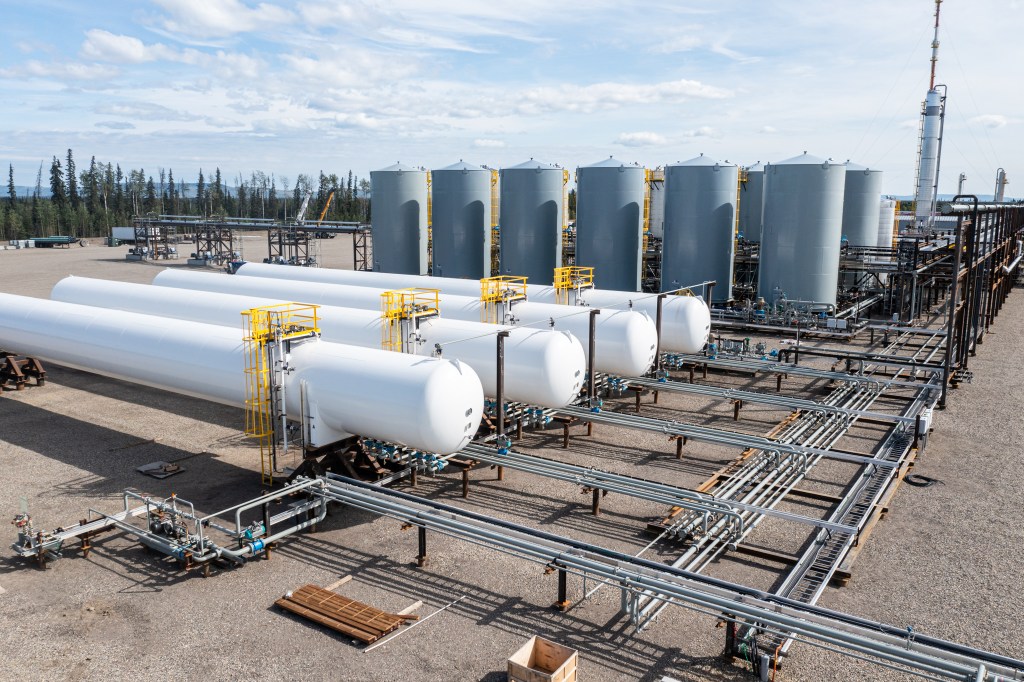
In 2024, Tourmaline began a two-phase project in the Groundbirch and Aitken areas, which when finished will consist of two new gas processing complexes with C3+ deep cut recoveries, expansion of four existing gas processing complexes, three hydrocarbon liquids hubs – including an LPG terminal at Groundbirch – five water recycling facilities, electrification of four processing plants including two existing plants, and pipeline corridors to connect the resource base to new and existing gas processing complexes.
So far Tourmaline has begun work on one of the liquid storage projects, a connector pipeline project, a water facility, the compression expansion at Groundbirch and one of the electrification projects. These are all expected to be completed by the end of 2025 at a cost of approximately $350 million.
“[The project is] certainly on the largest EP projects in the Western Canada Sedimentary Basin. We have been systematically consolidating and delineating the northeast BC Montney gas/condensate complex for over five years, and we’re now entering the next phase, wherein the significant financial benefits of all those activities, which began during Covid, will be fully realized.”
The project is anticipated to add 1.1 billion cubic feet per day (bcf/d) of new gas production, and over 50,000 bpd of condensate and natural gas liquids over the next six years, from two new deep-cut gas plants; one in the North Montney and one in the South Montney.
The first production addition is scheduled to start in Q4 of 2026 with the Aitken C-38-C plant expansion, and the next significant addition is Phase 1 of the Groundbirch 15-25 deep cut planned for the second half of 2027.
“We’ve been building gathering and processing infrastructure across northeast BC and the Alberta deep basin since the company started, including over 10 new processing facilities, so we’re good at this and our cost management is very strong,” Rose said.
“Importantly, both of these projects have all the necessary permits, and long-lead procurement is underway.
“Once the northeast BC infrastructure build-out is completed early next decade, the production growth rate is expected to drop, and the company intends to migrate towards a maintenance capital level which we currently estimate at about $2.5 billion per annum to maintain 850,000 boe per day.”
Enbridge is also expanding its assets in the Montney with three projects scheduled to be in service between 2026-2028.
The first two projects involve expansion of the Westcoast Energy Inc. gas transmission system known as the T-North system. The Aspen Point Program, which is scheduled to be in-service by 2026, will add approximately 18km of pipeline, electric driven compressor units with powerlines, a new meter station, and associated compressor station modifications, providing up to 535 mmcf/day of new transportation capacity, and cost $1.2 billion.
The second project in the T-North system, the Birch Grove project aims to add up to 178 mmcf/day by Q3 of 2028 for a cost of $400 million. Like the Aspen Point program, Birch Grove includes the installation and replacement of pipeline segments, as well as piping upgrades and modifications at existing compressor stations.
Expanding the storage capacity at North Aitken Creek to support the growing west coast LNG export demand is the third project in the Montney that Enbridge has on its books. Added to its secured growth project plan in Q1, the planned 40 billion cubic foot expansion involves additional onsite wells, compression and facility modernization, enhancing existing withdrawal capacity and throughput. Enbridge expects this project to cost approximately $300 million and be in service by 2028.
“Aitken Creek is the only underground natural gas storage facility in the province, and we’re proceeding with a 40 bcf expansion which will provide enhanced flexibility for our LNG related customers,” Enbridge president and CEO Greg Ebel said during the company’s Q2 conference call.
“The issue is not one of there being a proponent, the issue is one of government policy setting the conditions for that investment to occur.”
Greg Ebel, Enbridge president, CEO
Apart from gas going to LNG facilities on BC’s west coast, the oil, natural gas and liquids extracted in northeastern BC goes to markets in the US, or in the case of Tourmaline through the US to Europe.
Right now, customers want their product to go south, since that’s where the premium market is. But with the Canadian government talking about diversifying its trading partners, and Alberta Premier Danielle Smith determined to find a way to get Alberta’s oil to tidewater, there may be opportunities to access other markets in the future.
Opportunities stifled by government policies
“As our customer production grows, that’s when an opportunity could be created to go to the West Coast,” Ebel said, adding that there has been much discussion with governments on that potential.
“We have been a proponent of such a project in the past, and in fact invested several hundred million dollars to get there,” he said, referring to the Northern Gateway pipeline project which although it received approval in June 2014, was cancelled by the Liberal government in November 2016, following the implementation of the tanker ban on the west coast of BC in 2015.
“The issue is not one of there being a proponent, the issue is one of government policy setting the conditions for that investment to occur,” Ebel said. “Let’s be honest, the government has not done that yet, it’s not clear that they intend to, at least from our perspective.”
There are nine government policies that petroleum companies find impact investment conditions in Canada including the emissions cap and the West Coast tanker ban.
Ebel says these two policies stifle Enbridge’s customers ability to grow oil production, and as long as the tanker ban is in place, “it would make building a pipeline to the West Coast being a pipeline to nowhere.”
“Nothing’s been deemed in the national interest either yet.”

Have an insight or additional info regarding this article? Feel free to drop a comment!