Progress doesn’t happen in isolation.
But British Columbia Premier David Eby seems determined to isolate the province and its people from progress and prosperity with his resistance to new petroleum development.
Nowhere is the impact of that resistance felt more than in northeastern BC, where new exploration and development is strangled by red tape – CleanBC emissions targets, policies that prioritize climate goals over economic growth, uncertainty over protected land, and prolonged permitting processes.
Resource extraction has been BC’s economic backbone for decades, but since taking over in 2017, NDP policies have cost the industry 30,000 direct and indirect jobs, upstream development is down 33 percent, and the Fraser Institute reports that BC has the greatest barriers to investment in Canada.
For example, in December 2017, the Crown Sale of Petroleum and Natural Gas Rights saw 24 drilling licenses offered for sale. Ten were purchased, with a Tender Bonus (Average price per hectare x number of hectares sold) of $882,835.72. In the December 2025 sale, just one lease was offered for sale. That 260ha parcel was purchased with a Tender Bonus of $54.860.00. The December 2025 sale marked one year since sales had resumed after a three-year hiatus following the Yahey Decision in June 2021.
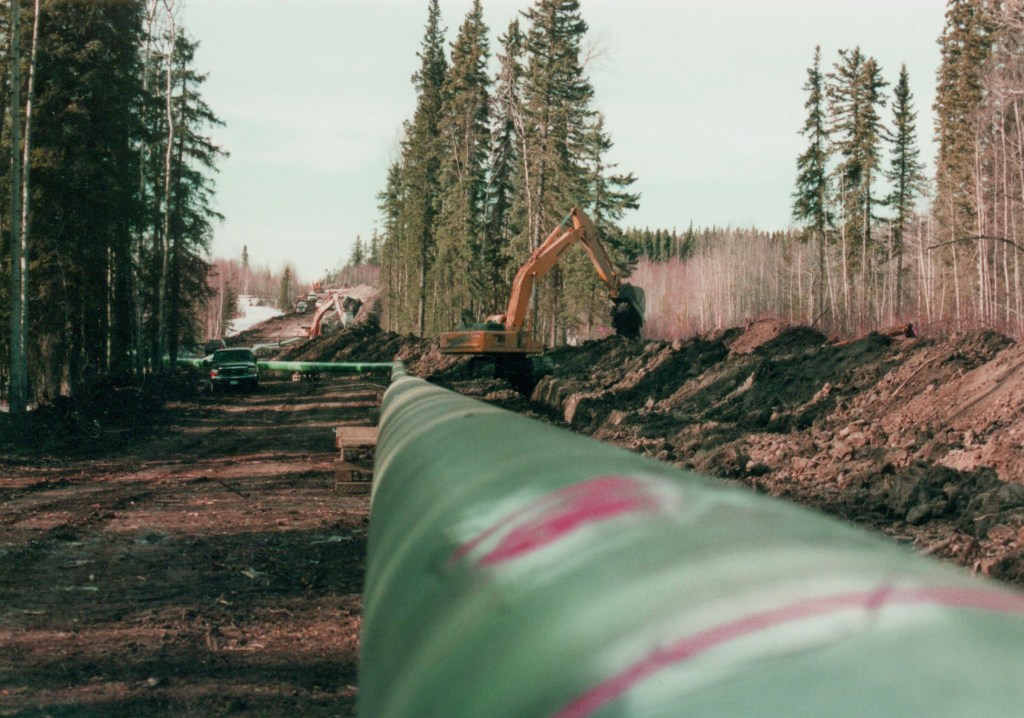
Now, with Canada looking to diversify its markets and find new trading partners, the spectre of a long-cancelled pipeline project from Alberta to the northwest coast of BC has risen, getting Eby’s back up in the process.
That project has been given an opportunity for revival via the Memorandum of Understanding which the federal government and Alberta signed on November 27, agreeing to work together to “unlock and grow natural resource production and transportation in Western Canada.”
Eby maintains that the project, sometimes referred to as Northern Gateway 2.0, has no proponent, no route, no money, and no First Nations support, and as a result British Columbia objects to the essence of the MOU.
“The bottom line for us, is that we need to make sure that this project doesn’t become an energy vampire,” Eby said at a press conference in Victoria following the announcement of the MOU.
“That it cannot draw limited federal resources, limited Indigenous governance resources, limited provincial resources away from the real projects that will employ people, provide the country with money that we desperately need and provide investment and access to global markets to deepen our trade relationships overseas.”
The pipeline project proposed in the MOU is similar to Northern Gateway, if not an outright revival, and it will provide jobs, revenue and access with private funds.
The MOU states that the project will involve the “Construction of one or more private sector constructed and financed pipelines, with Indigenous Peoples co-ownership and economic benefits.”
Alberta commits to “collaborate with BC to ensure British Columbians share substantial economic and financial benefits of the proposed pipeline.”
But Eby says that there is “limited bandwidth” in BC and the focus should be on projects they can deliver, that spending time on a project that isn’t a real project isn’t BC’s priority.
“[Our] priority is delivering for families in terms of real economic development that will continue.”
It appears that in the premier’s mind, British Columbia has a finite capacity for projects, jobs, collaboration and revenue. All the while unemployment is increasing, basic costs such as food and housing are increasing, and the province’s debt is increasing.
The project discussed in the MOU is non-existent says Eby and could “actively compromise projects here in British Columbia that are real and meaningful and will actually make a difference in British Columbia for people who live here, for our government’s finances, for federal government finances and so on.”
Yet every new business, every new project that has provided jobs, revenue for the government, put food on the table of British Columbians started out as an idea. As a proposal.
The MOU doesn’t say that an oil pipeline through BC is a project that will be pushed through at the expense of all other projects. In fact, it says that not only will Canada and Alberta engage with BC during the development and construction of the pipeline project but will “further the economic interests of BC related to their own projects of interest that involve the Province of Alberta including interties,” and that “Canada will work with BC on other projects of national interest in their jurisdiction.”
It also talks of constructing transmission lines with BC and Saskatchewan “to strengthen the ability of western power markets to supply low carbon power to oil, LNG, critical minerals, agricultural, data centres and CCUS industries in support of their sustainable development goals.”
This would help BC reach its electrification and emissions reduction objectives as outlined in the CleanBC policy.
Hardly an energy vampire.
The government is supposed to be in the business of creating an environment where the private sector wants to invest and get things built, rather than crushing the economy with its red tape.
As Enbridge CEO Greg Ebel said during the company’s Q2 conference call earlier this year, “The issue is not one of there being a proponent, the issue is one of government policy setting the conditions for that investment to occur.”
“Let’s be honest, the government has not done that yet, it’s not clear that they intend to, at least from our perspective,” Ebel said.
Now the federal government has said that through its Major Projects Office, the hinderances to development can be waived for projects in the national interest. The MOU describes a similar project to the one that Enbridge spent several hundred million dollars on before it was cancelled by Prime Minister Justin Trudeau’s tanker ban a decade ago and has been deemed in the national interest.
Progress and prosperity don’t happen in isolation. Pipelines aren’t fictional or vampires. They’re infrastructure. Infrastructure which gets a sought-after product to market.
If there’s a demand for oil in Asian markets, as Alberta Premier Danielle Smith believes there is, refusing to “allow” a pipeline through British Columbia to Canada’s west coast isn’t going to stop the demand for oil. It’s simply going to hand that opportunity to the United States, giving them more jobs, more revenue and more of Canada’s abundant resources at a discount as they make use of the product already flowing south from the oilsands in Alberta.
By and large, the petroleum companies operating in Canada are American.
That doesn’t mean the jobs have to go to Americans.
That doesn’t mean the tax revenues have to go to the United States. They could stay here, in British Columbia and show the world that we’re open for business, that we encourage and welcome new investment and new ideas to grow the economy.
Rather than cutting our own economic throats. Rather than isolating British Columbia from the opportunity to capitalize on the abundant resources the country possesses and grow the economy.
While the pipeline project outlined in the MOU wouldn’t – if it follows the same projected route as the original Northern Gateway – go through much of northeastern BC, the region has the companies with the experience, the technology and the know-how to build that pipeline.
We could build it. Eby could create the conditions or support the federal government’s creation of conditions to make the project a reality.
Unless of course, the government wants to keep reaping the rewards of years of bad policies that are driving the province’s young people away to find employment, prosperity and hope across the border in Alberta.

Have an insight or additional info regarding this article? Feel free to drop a comment!